
The History of a Future Platform, Part 2: Stunt Island
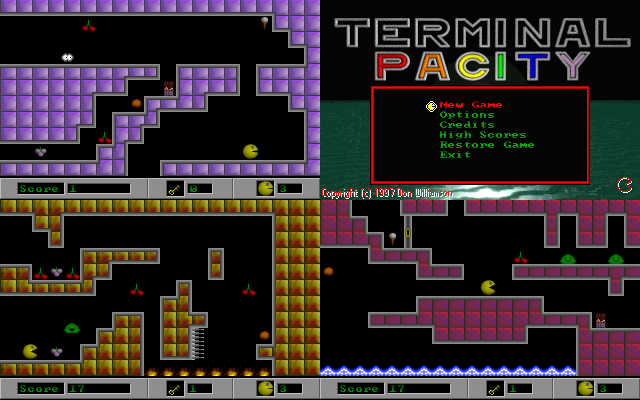
I'm a late 80s to late 90s gamer: some of my most imprinted memories come from that period. I remember vividly two incredible WOW! moments that changed my life.
My attempt to rethink the way games are made. In 2012, after shipping Fable 3 on Xbox 360 and PC, supporting DLCs and helping the team transition to Unreal Engine 3, I was completely worn down and demoralised.
I'm a late 80s to late 90s gamer: some of my most imprinted memories come from that period. I remember vividly two incredible WOW! moments that changed my life.
The goal is to reduce the final solution from Part 1 even further so that the technique can be used frequently in shaders.
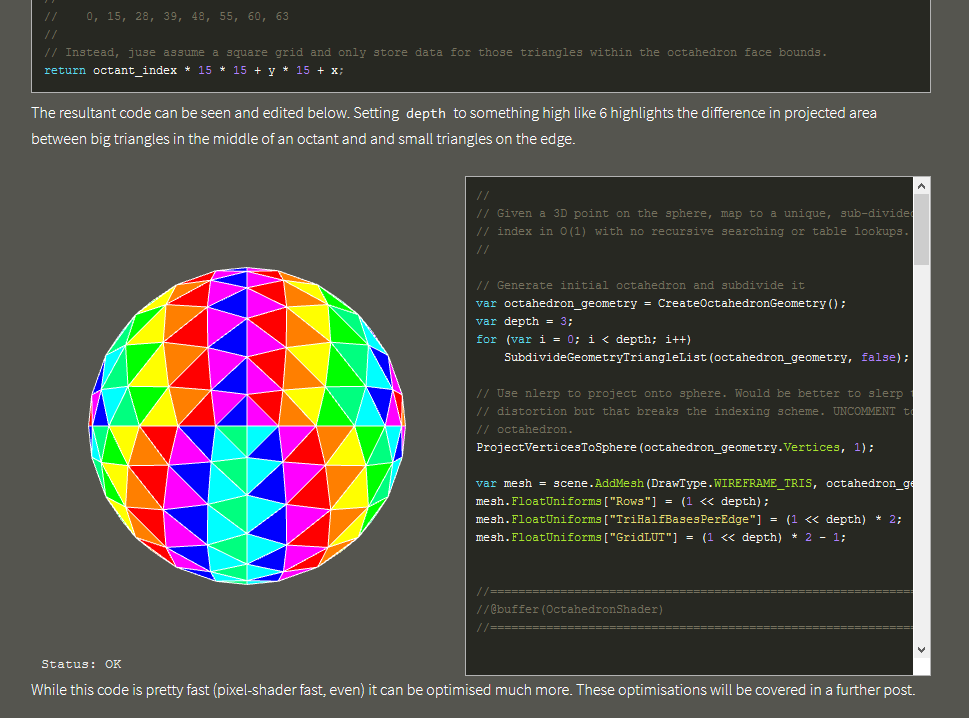
Map any 3D point on or above a triangle-subdivided sphere to a triangle index in constant time, without recursion, table lookups or complicated branching logic.
Around the age of 15 I started to code after a family friend gave me a BBC Microcomputer Model B. It was a wonderful machine that showed me where my future lay.
I considered removing comments from the blog after looking into Disqus load-time behaviour and seeing what it was imposing on visitors.
Getting frustum points in world space is useful for debug visualisation or building a coarse volume around a partition in your frustum.
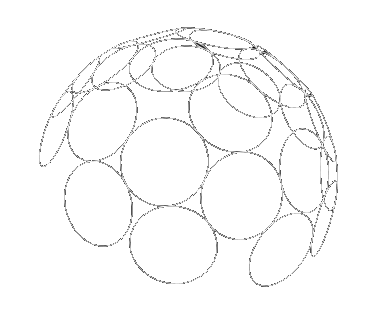
In the Tammes problem, distributing points evenly on a sphere is important; the radius of circles placed at those points is often less considered.
A technique for achieving double-resolution noise at speeds close to float arithmetic, by restricting double arithmetic to the ranges where it is needed.
A return to the site after its old domain went dark, with changes to hosting, domains and the generation workflow.
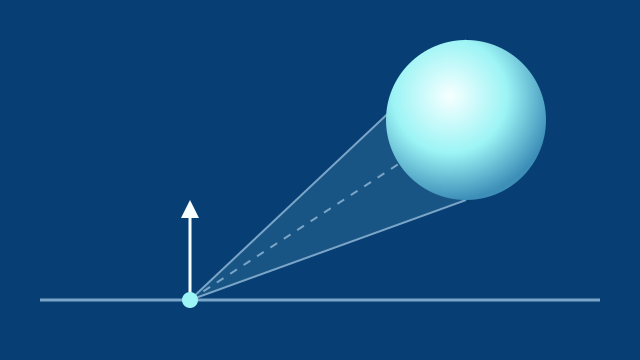
A small mathematical study of spherical light sources, reducing a shader expression for distant lights to something practical.
How shifting the coordinate frame in gradient noise improves precision, enabling fast large-scale procedural noise on GPUs and SIMD hardware.
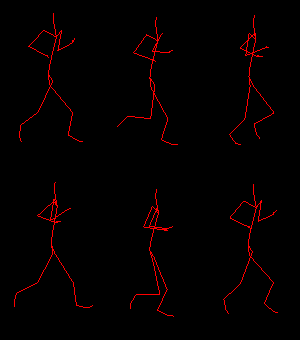
Using autocorrelation to find convincing loops inside non-exact motion-capture animation, then cross-fading the seams.
Quaternions, their geometric intuition, and practical dual-quaternion skinning in a graphics pipeline.
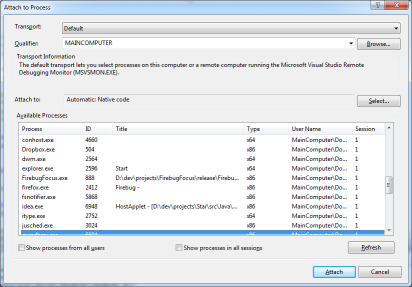
A Visual Studio debugging workflow for a client/server game architecture, including process attachment and startup synchronisation.
A detailed look at reflection used to build the Splinter Cell rendering engine, tooling, serialisation and runtime inspection.
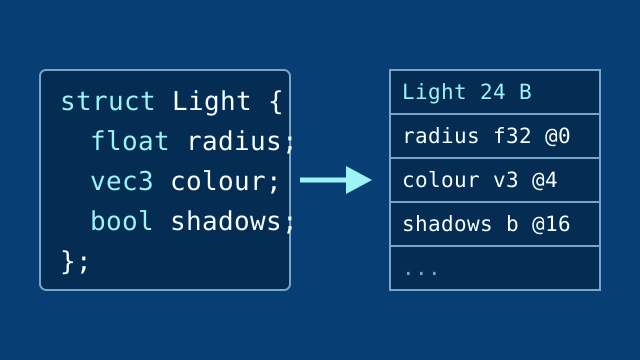
Why reflection matters in C++ game engines, and what becomes possible when type information is available at runtime.